Odessa, FL



Tampa SEO Company | Tampa, FL
Tampa SEO Company Helping Businesses Grow in Tampa, Florida
Drive more qualified traffic, leads, and customers with strategic SEO services built for Tampa businesses. From local search and Google Maps visibility to technical SEO and content optimization, we build search strategies around measurable business growth.
Get Your Free SEO Audit
google.com/search?q=tampa+seo
Organic Traffic
+147%
Local Visibility
Top 3
MAP
Google Business Profile
Keyword Rankings
tampa seo company
#1
seo services tampa fl
#1
local seo tampa
#2
98
Site Health
Technical SEO Score
Best SEO Company in Tampa, Florida — Drive More Traffic, Leads & Revenue
Looking for a Tampa SEO company that focuses on more than rankings? VSF Marketing helps Tampa businesses improve their visibility in Google Search, Google Maps, and other local search results while turning that visibility into qualified leads and customers. As an SEO Company Tampa, we focus on building search visibility that supports measurable business growth.
Our Tampa SEO services combine technical SEO, keyword research, on-page optimization, local SEO, content strategy, link building, and performance tracking into one focused search strategy. We don't use a one-size-fits-all approach. Instead, we build campaigns around your business, your market, your competitors, and the searches your potential customers are actually making. Our approach is designed for businesses looking for SEO Tampa Florida strategies that align with their local market.
Whether you're looking for an SEO company in Tampa, SEO services in Tampa, or a local SEO agency that understands the Tampa market, our goal is the same: improve your search visibility, attract the right audience, and create more opportunities for your business to grow.
For Tampa businesses competing in local search, that means optimizing the areas that matter most — organic rankings, Google Maps visibility, relevant service pages, helpful content, technical performance, and authority.
More Visibility
Qualified Traffic
More Leads
Our Tampa SEO Services
Our SEO services in Tampa are designed to improve every part of your search presence — from technical performance and keyword targeting to local visibility, content, and authority. Our Tampa SEO Service approach is tailored to your business goals and search opportunities. Each service works together to help your website earn stronger rankings and generate more qualified opportunities.
Website Audit & Competitor Analysis
We start with a detailed SEO audit of your website to identify technical issues, content gaps, ranking opportunities, and conversion barriers. We also analyze competing Tampa SEO companies to understand what is helping them rank and where your business can gain an advantage.
Keyword Research & SEO Strategy
We identify the search terms your potential customers use when looking for your products or services. Our strategy combines high-intent Tampa SEOkeywords with relevant local and industry-specific searches to build a clear roadmap for your website and content.
On-Page SEO Optimization
We optimize page titles, headings, content, internal links, images, and other on-page elements around real search intent. The goal is to make each important page easier for search engines to understand while giving visitors clear, useful information that supports conversions.
Technical SEO Optimization
We improve the technical foundation of your website by addressing crawlability, indexing, site speed, mobile usability, structured data, redirects, and other technical SEO factors. A technically sound website gives search engines a stronger foundation for discovering and ranking your content
Local SEO for Tampa Businesses
We improve your visibility for Tampa Local SEO searches through Google Business Profile optimization, local citations, relevant location signals, review strategy, and locally focused content. This helps Tampa businesses compete for searches that can lead to calls, visits, and local customers.
SEO Content Creation & Optimization
We create and improve content around the questions, services, and topics your target customers search for. Each piece is structured to provide clear answers, demonstrate expertise, support related service pages, and create useful internal linking opportunities across your website.
Link Building & Authority Growth
We build relevant, high-quality backlinks that strengthen your website's authority and support competitive Tampa search terms. Our approach focuses on relevance and quality rather than collecting large numbers of low-value links.
SEO Performance Tracking & Reporting
We track keyword rankings, organic visibility, traffic, leads, and other meaningful SEO signals so you can see what is improving and where the strategy needs to adapt. Our reporting connects SEO activity with measurable business outcomes instead of focusing only on ranking numbers.
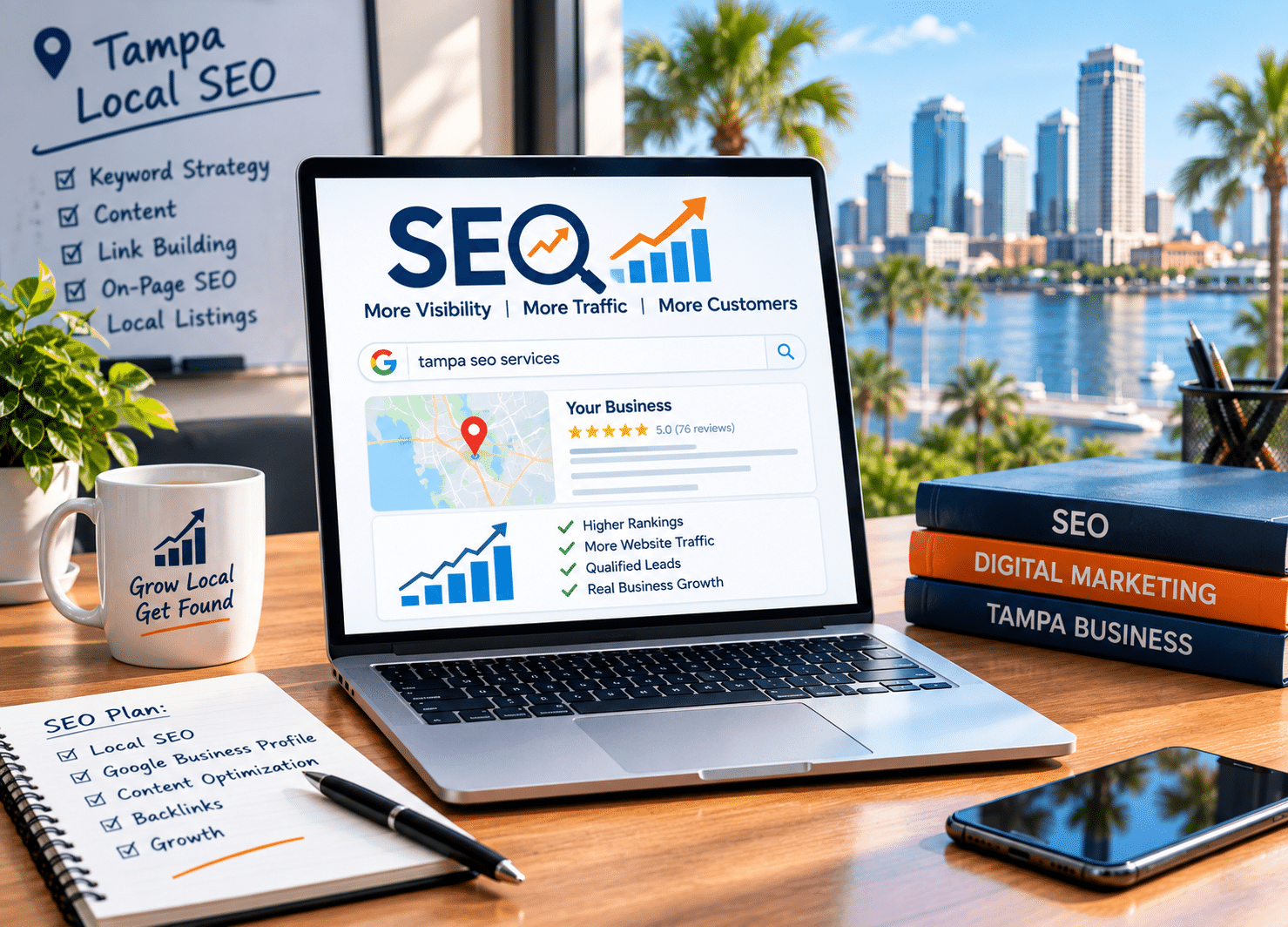
Why Tampa Businesses Choose VSF Marketing for SEO
Choosing the right SEO agency in Tampa is about more than finding someone who can improve keyword rankings. Your SEO strategy should help the right customers find your business, understand what you offer, and take the next step. As an SEO Agency Tampa businesses can work with, VSF Marketing focuses on building strategies around those goals.
VSF Marketing combines local SEO, technical optimization, content strategy, keyword research, on-page SEO, and authority building to create a complete search strategy for Tampa businesses. We look at your website, competitors, industry, search intent, and business goals before deciding where to focus. As a Local SEO Agency Tampa businesses can rely on, we also consider the local search factors that affect visibility in the Tampa market.
For businesses targeting Tampa customers, we also focus on the local signals that influence visibility in Google Search and Google Maps. That includes Google Business Profile optimization, local relevance, location-focused content, reviews, citations, and strong service pages.
Our approach is built around measurable progress. We track rankings, organic visibility, traffic, and lead opportunities so the SEO strategy can be adjusted as your market and search results change.
What You Get From Our Tampa SEO Strategy
A structured approach to improving your visibility and growth in the market. We focus on areas that actually drive revenue.
Local Search Visibility Improve visibility for Tampa and nearby location-based searches.
Technical SEO Foundation Fix crawlability, indexing, performance, mobile and other technical issues.
Search-Intent Driven Content Create useful content that answers what potential customers are actually searching for.
On-Page Optimization Improve titles, headings, content structure, internal links and page relevance.
Competitor-Focused Strategy Identify ranking gaps and opportunities against competing businesses.
Performance Tracking Monitor rankings, organic visibility, traffic and lead-generating opportunities.
Ready to Compete for More Tampa Search Traffic?
See where your website is losing search visibility and where your biggest SEO opportunities are. We'll identify the areas that can help your business compete more effectively in Tampa search results.
Get a Free SEO Audit
Tampa SEO Services for Local and Service-Based Businesses
Different industries compete for different searches, so effective SEO needs to reflect the way customers search for each service. VSF Marketing develops industry-focused SEO strategies designed around your services, location, competitors, and customer search behavior.
1. HVAC SEO
Reach homeowners searching for heating and cooling services in Tampa with local SEO strategies built around service-area searches, high-intent keywords, Google Maps visibility, and lead generation.
2. Roofing SEO
Build stronger visibility for roofing services and generate more qualified leads through local search optimization, service-focused content, and authority building.
3. Healthcare SEO
Help healthcare businesses improve organic visibility and connect with people searching for relevant services in the Tampa area.
4. Legal SEO
Improve search visibility for law firms targeting Tampa-area clients with focused local and service-specific SEO strategies.
5. Contractor SEO
Generate more project opportunities by optimizing your website and local presence around the services and locations your customers search for.
6. Home Services SEO
Increase visibility for plumbing, cleaning, maintenance, and other home-service businesses competing in Tampa local search.
7. Ecommerce SEO
Improve product and category visibility with SEO strategies designed to help ecommerce businesses attract qualified organic traffic and online buyers.
8. Local Business SEO
Help Tampa businesses compete for nearby customers through local search optimization, Google Maps visibility, relevant content, and location-focused SEO.
See How Strategic SEO Helps Businesses Compete and Grow
Experience the transformation of businesses that trusted the blueprint.
Tree Services


Panorama Tree Care
+523%Traffic
+410%Leads
+288%Calls
"VSF helped us dominate the first page of Google with massive growth in traffic and leads."
Panorama Team→
Inspection

HIG Home Services
+211%Traffic
+316%Leads
+188%Calls
"Our business has grown exponentially with VSF's digital marketing strategies."
Mark Thompson→
Waste Management

Best Price Dumpster
+312%Traffic
+425%Leads
-61%CPL
"The ROI from VSF Marketing has exceeded all our expectations significantly."
Steve Martinez→
Moving

Florida Main Movers
+287%Traffic
+350%Leads
+398%Calls
"I love VSF Marketing. They listen to all my needs and always find a solution."
Attorney Brandon→
Electrical

Florida Power Tech
+412%Traffic
+488%Leads
+358%Calls
"The online visibility of our company has skyrocketed with 50+ first page rankings."
Sarah Thompson→
Cleaning

SteamWorks
+245%Traffic
+317%Leads
+312%Calls
"I can't say enough about the great job VSF did on redesigning our website."
Jeff Barnhart→
Buildings

Royal Maintenance
+318%Traffic
+445%Reach
+289%Calls
"VSF Marketing delivers real, measurable results for our facility business."
Lisa Anderson→
Specialist
Turnover Specialists
+187%Traffic
+412%Sessions
+218%Calls
"We now dominate local search results in our area thanks to VSF's expertise."
Robert Williams→
Restoration

Best Restoration
+271%Traffic
+423%Leads
+288%Calls
"VSF's digital strategy has helped push our vision forward in the market."
Maria Garcia→
Healthcare

MedBest Agency
+281%Traffic
+248%Leads
+212%Calls
"The influx of enquiries has made us a sought-after recruitment firm."
Kevin Taylor→
Chiropractic Care

Wesley Chapel Chiropractic
+53.4%Traffic
+30.8%Leads
+28.5%Calls
"Best marketing investment we've ever made for our clinical practice."
Dr. James Wilson→
Surgeon

Dr. Iswanto Sucandy
Top 5Rankings
+45.6%Traffic
+31.8%Leads
"VSF has brought tremendous awareness to my liver surgery practice."
Dr. Sucandy→
Family Law

Brandon Divorce Lawyer
+336%Traffic
+248%Leads
+33.4%Calls
"VSF Marketing actually delivers real business results for our law firm."
Attorney Smith→
Legal
Lizbeth Potts Law
+24.7%Traffic
+31.9%Leads
+31.2%Calls
"VSF continues to raise awareness and drive quality leads for my firm."
Lizbeth Potts→
What Our Clients Say About VSF Marketing
Results matter, but so does the experience of working with an SEO partner. Here's what some of our clients have shared about working with VSF Marketing.
E
Emily Rose
⭐⭐⭐⭐⭐
"Aaron helps us here at Bradley Termite & Pest Control with our website and SEO, and he's a joy to work with! His team is awesome and anything we need, they get it done!"
M
Matthew Miller
⭐⭐⭐⭐⭐
"Working with Aaron Hurlburt, VSF Marketing, on SEO and website initiatives, has been of great benefit. Our Google rankings have improved dramatically and we're receiving regular leads locally."
C
Christian K
⭐⭐⭐⭐⭐
"VSF Marketing has been a huge asset to our social media and SEO strategy. They've been able to move us up to page one on google for many of our key search terms. Great work ethic."
N
Nancy Summers
⭐⭐⭐⭐⭐
"...with Aaron and he has done a great job on each one. He is patient, knowledgeable, responsive and a really nice guy. His SEO skills are great. I will definitely use his services again."
T
Tony Padgett
⭐⭐⭐⭐⭐
"Aaron is an SEO consultant that will work with you to get you where you want to be. I have enjoyed his continual professional support over the past year as he helps us meet our goals."
J
Jody Santillo
⭐⭐⭐⭐⭐
"VSF Marketing built my business into a national brand. Very professional and informative throughout the entire process."
Frequently Asked Questions About Tampa SEO Services
Have questions about SEO for your Tampa business? Here are answers to some of the most common questions about Tampa SEO companies, local SEO services, rankings, and working with an SEO agency.
What does a Tampa SEO company do?
A Tampa SEO company helps businesses improve their visibility in Google and other search results so potential customers can find their products or services more easily. SEO services can include keyword research, on-page optimization, technical SEO, content optimization, local SEO, link building, and performance tracking. The right strategy depends on the business, its competition, target customers, and search goals.
Why should I hire a local SEO company in Tampa?
A local SEO company in Tampa can build a strategy around the searches, customers, competitors, and locations that matter to your business. Local SEO can help improve visibility in location-based Google searches and Google Maps while making your website and business information more relevant to customers searching in the Tampa area. **For businesses looking for a Local SEO Company Tampa, this local market focus can be especially useful.**
How can I choose the best SEO company in Tampa, FL?
Look for an SEO company that can explain its strategy clearly, show relevant experience, provide transparent reporting, and focus on measurable business outcomes rather than rankings alone. For example, an SEO Company Tampa FL should be able to explain how it approaches technical SEO, content, local search, links, and ongoing optimization before starting a campaign. If you're considering an SEO Consultant Tampa, review their experience with similar businesses, service areas, and search goals.
What are local SEO services in Tampa?
Local SEO services in Tampa are designed to help businesses become more visible when people search for products or services in the local area. These Local SEO Services Tampa can include Google Business Profile optimization, local content, citations, reviews, location-focused service pages, on-page SEO, and other signals that support local search visibility.
How long does SEO take to show results in Tampa?
SEO does not have a fixed timeline because results depend on competition, website condition, existing authority, content quality, technical issues, and the strategy being implemented. Some improvements can appear earlier, while more competitive Tampa search terms can require several months of consistent optimization and authority building.
Can Tampa SEO experts help small businesses compete in local search?
Yes. Tampa SEO experts can help small businesses improve their visibility for relevant local searches by focusing on location-specific keywords, Google Business Profile optimization, useful service content, technical SEO, reviews, and other local search signals. Working with Tampa Local SEO Experts can also help businesses build a strategy based on their services, service area, competition, and customers.
What makes a Tampa SEO agency different from a general SEO company?
A Tampa-focused SEO agency can build its strategy around the local market, service areas, competitors, and search behavior relevant to Tampa customers. That local context can be especially important for businesses that depend on phone calls, appointments, local visits, or service-area leads. A Tampa SEO Agency can use this local context to align SEO efforts with the needs of Tampa customers.
How does VSF Marketing approach SEO for Tampa businesses?
VSF Marketing combines technical SEO, keyword research, on-page optimization, local SEO, content strategy, link building, and performance tracking to create a search strategy around each business. The goal is to improve relevant search visibility and turn that visibility into qualified traffic and business opportunities. Our approach can also include SEO Consulting Tampa businesses may need when developing their search strategy.
Free Consultation
Request Your Free SEO Consultation
Complete the form below to schedule your complimentary consultation. We'll evaluate your current website, discuss your objectives, and recommend a customized strategy that helps your business improve visibility, attract qualified leads, and achieve sustainable organic growth.
What You'll Receive
- Comprehensive Website Evaluation
- Objective & Goal Discussion
- Customized SEO Strategy
- Roadmap for Organic Growth
Loading Form...
No Obligation Consultation
Custom SEO Strategy
Response Within 1 Business Day
Let's Grow Your Tampa Business
Request your free SEO consultation and receive a customized growth strategy for your business.
Thanks! Our SEO team will review your website and contact you within one business day.